Restoring Language, One Wave at a Time
Aphasia — the loss of language function following stroke — affects more than 1 million people in the United States and represents one of the most devastating and least tractable consequences of brain injury. Standard speech-language therapy can support recovery, but outcomes plateau early for many patients, leaving a substantial proportion with persistent and disabling communication deficits. The neural basis of language recovery is known to involve the re-engagement of perilesional language networks, particularly in the left hemisphere, through oscillatory activity in the gamma and beta frequency bands. What has been missing is a stimulation approach precise enough to target these rhythms at the individual level, in real time.
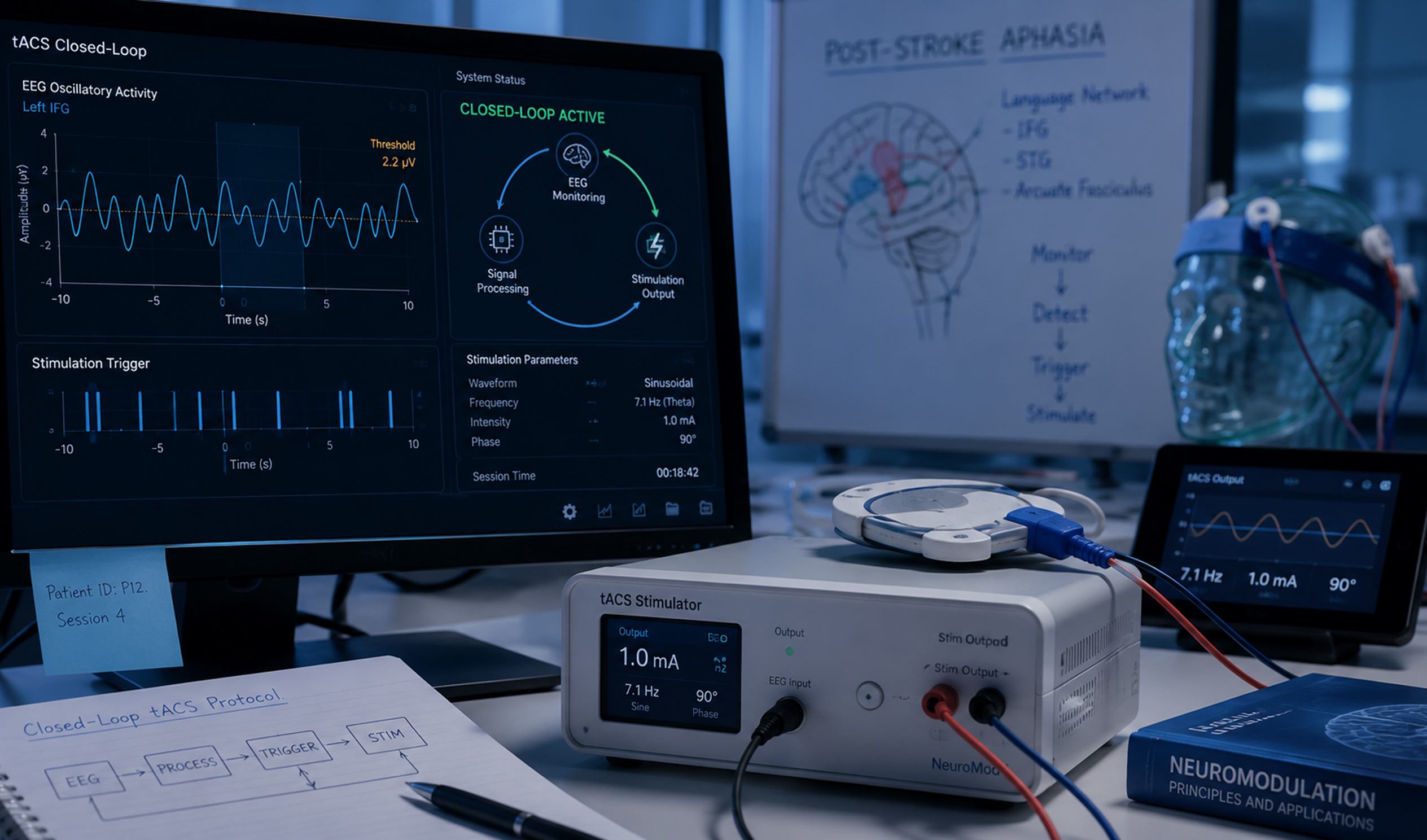
Dr. Harvey’s project develops a closed-loop alternating current stimulation (tACS) protocol for post-stroke aphasia that adapts to each patient’s own neural oscillatory profile, delivering stimulation at the individualized frequency and phase most likely to enhance language network engagement. Unlike open-loop paradigms that apply fixed stimulation parameters regardless of neural state, this approach is responsive to the patient’s ongoing brain activity — a step toward truly personalized neurorehabilitation. The study will characterize the relationship between oscillatory dynamics, stimulation parameters, and language recovery outcomes, building the mechanistic foundation for a larger efficacy trial that could change the trajectory of care for aphasia patients.